Purple Top Strap Leaf Turnip Photos

Purple Top Strap Leaf is the 2nd of the four turnips I’m growing out for the Seed Savers Exchange M-GEN trial.

Once again, this is a turnip that Google won’t help you find seed for.  I haven’t tasted it yet, but the quick Google search found some unhappy Alaskian researchers who found the turnips large, but pithy.  The ones I sliced open for photos looked okay so hopefully, it’s an extreme north thing!

Here are the sliced roots:

PT%20Strap%20Leaf%20roots[1].jpg

Here are the turnip greens:

PT%20Strap%20Leaf%20leaves[1].jpg

Here are the roots and leaves, fresh from the ground:

PT%20Strap%20Leaf%20roots%20and%20leaves[1].jpg

The Milan Early Red Top Turnips tasted fantastic — sweet, bright and without a hint of sulfur.    These turnips look pretty conventional to me, but hopefully, they will taste better than the standard supermarket turnip.  At the very least, they are fresh!  As this variety produces a lot of greens, I bought some ham hocks to cook the greens with.  Stay tuned to see how they taste!


Tom and Chris Henry Finish the Block Building

The Block Building is finished!  There will be a final inspection this week from the township, but we all expect that it will go well.
Pictured in front of the loft steps are Tom Henry and his son, Chris.  They have fixed Hill Creek Farm’s cart shed, barn and now Block Building.  Hopefully, the budget will allow us to hire them in the Spring to create a greenhouse in the barn’s former milking parlor
(If you’d like a reference for the Henrys, just drop me a line or page through the Building Category of this blog for examples of their work)

Tom%20Chris%20loft[1].jpg


Milan Early Red Top Turnip Photos

Now that the frost has come, it’s time to make stew.  With all the turnips I did for the 2014 Seed Savers Exchange M-GEN turnip trial, it’s time to harvest those turnips, take some photos, then cook them in stews and eat them!

Since I never had it before, I decided to try the Milan Early Red Top Turnip first.   It appears to be so rare that I couldn’t get a commercial seed source on Google.  You’ll have to join Seed Savers Exchange to access this seed!

Here’s what the greens look like:

Milan%20turnip%20greens%202014[1].jpg

Here are the roots:

Milan%20Turnip%20Cut%20Roots%202014[1].jpg

Here are the turnips fresh from the ground:

Milan%20turnip%20greens%20and%20roots%202014[1].jpg

There are still plenty of Milan Early Red Top turnips in the ground.  If you want to purchase them or the Gold Ball Turnips which I planted just for fun and try these rare, but tasty varieties, just drop me a line!


Ursinus College Class of 1984 Reunion

Saturday, October 25 was Homecoming at Ursinus College.  It was also the 30th anniversary reunion for the my class, 1984.

untitled.png

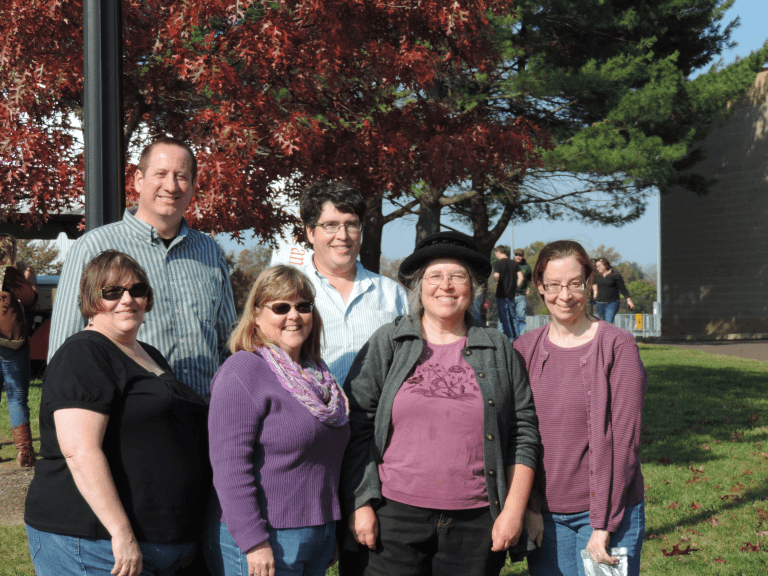
In the back row are Steve Scoffone and Ed Stemmler.  The front row are Susan Colaiezzi Short, Carole Johnson Butler, me and Ingrid Meier.

I was a biology major/French minor at Ursinus and was the editor of the literary magazine, The Lantern, my junior and senior years.  My mother graduated from Ursinus in 1956 as a mathematics major/physics minor.  We both sang “Messiah” in the College Choir.  My mother is pictured in the photo in Bomberger Hall that shows a Messiah performance from the mid-1950s.

It was great to spend time with the people I saw.  Hopefully, I’ll see other classmates in the future.


2014 Garlic Planted!

The garlic is planted!  I’m now about 1/3 of the way done with mulching, but even in cool, fall weather, it’s hot work, so I came inside for some iced tea.
Here is how the garlic beds looked planted:

garlic%20beds%202014[1].jpg

Each stake represents a different variety.  I mix up the stakes (wood, metal and pvc pipe) so that it’s easier to tell where the different varieties are over a messy winter.
The 14 varieties of 2014 garlic are:
German Extra Hardy
German Red
Georgia Fire
Metechi
Music
Kettle River Giant (Utah)
Italian Arctic
USDA varieties from:
Belarus
Czech Republic (a softneck and a hardneck)
Korea
Uzbekistan (a brown cloved skinned variety and a white clove skinned variety)
Tajikistan


Newly Designed Garlic Planter Working Great!

In Southeastern Pennsylvania, garlic should be planted from Columbus Day up to the end of October.  On their own, the cloves will begin to break dormancy at this time and begin pushing out roots on their stub end and green shoots at their pointy end.
It’s time to get them in the ground so that they can develop those roots to keep them anchored in the ground when the frost causes heaving and to help them find nutrients and water over the Winter and Spring.  Given enough time (thus Fall, rather than Spring planting), garlic roots can delve down six feet and find enough water in early Spring to not need irrigation.   I haven’t watered my garlic in years and specifically choose varieties that don’t need water in Southeastern PA.
At the community garden, I used rulers and sticks to plot out where the cloves should be planted.  However, up-scaling from garden to farm meant that we needed a more standardized, reliable and replicable means of planting the 3,000 cloves we’d like to put in the ground this year.
Frank’s answer is in his hands here:

Frank%20garlic%20planter[1].jpg

The garlic planted is the length of the beds (6 feet).  The 11 PVC pipes are pointed so that they can sink into the ground when the top of the planted is pressed down.  In great soil, they can go down up to 3 inches (in practice, the rocks and clay soil often simply mark where the clove goes, but that works, too!) so that one can simply drop the clove into the hole and toss soil over it.  Each PVC pipe is 6 inches apart.  At the ends of the planter is a horizontal piece of wood with 6 inches (for small varieties) and 8 inches (for larger varieties) to set the next row of holes.
Here is how the garlic planter works in the field:

garlic%20planter[1].jpg

In retrospect, after plowing for the raised beds, we should have lightly tilled the top of the beds to make the top more even so that the PVC pipes could make more even holes in the bed.  Then, we could just drop in the cloves and pinch the soil to cover the holes as we expected.  With the uneven top, I’m taking soil out of the drainage trenches around the beds and putting the soil over the cloves so that they are well-covered.  That takes a lot more time.  Also, the garlic planter works best with 2 people, but most of the time, I’m using it alone.  (If you’d like to help plant garlic with the planter, just e-mail!  I’d be thrilled to have someone both to help and to talk to! :-))

So far, I’ve planted 10 varieties of garlic, including German Extra Hardy, Georgia Fire, Music, Metechi and ones from USDA collecting trips to Belarus, Czech Republic (a softneck!), Korea (really unique looking scapes), Uzbekistan (both a purple clove skinned and a white clove skinned), and Tajikistan.  I’ll probably add another 4 or 5 varieties before I’m done.

Frank’s garlic planter makes planting easier, but it’s still a “knees in the ground/Mike Rowe-worthy ‘Dirty Job'”.  Utimately, however, it’s very satisfying to see the garlic stored in the barn shrink down as it makes its’ way outside and in the ground for its’ long winter root growth.

As a final step, the beds will be mulched with hay/chopped leaves to keep the root/shoot juncture protected during the increasing bitter frosts as Autumn turns to the steady cold of Winter.

Right now, however, it’s still October and we’re still planting.  I leave you with this picture of Denise and Mochachino (the barn cat) in the field with the garlic planter, placing the cloves into the ground.

Denise%20Mochachino%20garlic%20planter[1].jpg


Poblanos to Ancho Powder

I am not much of a hot pepper person.  Yes, the shapes and colors are lots of fun, but taste is often sacrificed for HOT!!!! which I don’t particularly enjoy.

The exception for me is when poblanos (the fresh stage of these peppers) are transformed into ancho’s (the dry state of this specific pepper), then ground into powder.  The result is smoky, sweet and just a bit hot — a complex flavoring that I enjoy adding throughout the winter to whatever I’m cooking.

The pablanos we grew this year looked like this:

Poblano[1].jpg

Every year, I say I’m going to make chile rellenos from our poblanos, but the season gets away from me and I have yet to do so.

Every year, I do strip the plants of both red and green poblanos, put them in the dehydrator (When my supermarket dehydrator died, I saved up for an Excaliber dehydrator  [link here] and it has been worth the expense.), then whirl the dried pieces in the blender to make a course powder that I put in glass jars and use throughout the winter.

This year’s harvest is pictured here:

ancho%20powder%202014[1].jpg

Many hot peppers aren’t harvested until they are at their ripe color, but poblanos are valued at both the red and green stage, so the resulting powder contains both colors.  The plants are so prolific that even when a decent number are red, even more green peppers are being produced.

If you haven’t tried fresh poblanos or dried anchos, they are both worth your time and culinary efforts.  Contact me if you’d like to try some from Hill Creek Farm!


Harvesting and Hulling Black Walnuts, Revisited

Since my first post about black walnut harvesting, I’ve learned a lot.

First and most important, I was wrong to store the whole nuts in the wire racks.  The hulls should come off immediately as when they decompose, the hull juices seep into the nuts and make them even more strong-tasting than they already are.

There are many, many websites that talk about how to remove hulls from black walnuts.  Most of the “professional” sites (no one can make a living from black walnuts, but some people have professional-level experience!) sneer at the old-fashioned way of running over the nuts with your car.  ” Too inefficient” they say (if they are dedicated) or “too dangerous” (if they are cautious).  Both agree that you have pieces of hull and walnuts flying everywhere and it’s a bother to pick them all up — or can be embarrassing if the walnuts and/or wet, slimy hulls hit someone.

The most accepted method is what I call “The Booted Foot.”  Mochachino, the barn cat, is supervising me as I execute this procedure:

Mochachino%20black%20walnut%20harvesting[1].jpg

I have a box of walnuts on the right, put six of them on the driveway macadam, then put my work-booted foot over each one and press into the macadam.  The hulls slip off and then I toss the hulls into the box on the left and walnuts into the bucket beyond the box.

We used this method during a Tuesday Night Potluck and Weeding Session and it worked well even with Tina and Sue wearing sneakers.  About 10% of the walnuts wouldn’t press out fromt the sneakers and I had to re-press with my sturdy work boot, but we managed to hull all the nuts in a reasonable amount of time.

You do want to wear gloves when hulling black walnuts; however, no matter what type of glove I wore, my thumbs were dyed brown from the nuts.  A friend suggested putting Vasoline on my thumbs and then wearing the gloves which I may try in the future.

The Web is divided about composting the hulls — some say that if the composting is done completely, the juglone from the black walnut which inhibits the growth of other plants, will be broken down and gone, while others say to simply put the hulls somewhere to break down where they won’t interfere with beloved plants.  I used them to fill in some sunken areas around the farm, away from crops I care about.

The other widely endorsed manner of hulling black walnuts is to put them in a cement mixer with water and a handful or so of grit and let it rip!  I am SO haunting Craigslist next year if this year’s crop of black walnuts is worth spending the cash for my own “home-sized” cement mixer!  The best of the articles I read on harvesting/hulling black walnuts (and includes the proper ratios for the cement mixer method!) is here:

The other advantage of the Cement Mixer Method is that the walnuts are nicely washed and hulled with this method.  Most sites recommend washing the remaining walnuts in a wire basket with a power washer to remove sticky hull pieces and remaining juices.   The rinse water is brown, brown, brown with juglone, so do this in a spot you aren’t picky about what does (or in this cause, doesn’t) grow there.

Next, the walnuts are laid to dry in a protected (so the squirrels don’t find them!), but airy place for a month to six weeks.  This gives you time to find a vise to crack them (no kidding — Frank wanted a vise and it took us trips to several stores to find a sturdy one!) because everyone agrees that not only will a regular nut-cracker not crack a black walnut, but black walnut crackers listed for sale on OTHER websites won’t do the job either!

Right now, I’m still at the harvest, hull and cure stage.  Check back in 6 weeks when the Tuesday Night Potluck and Weeding Crew tries to actually crack the black walnuts and extract the nuts so that we can all have black walnut cookies for Christmas!


Frank Mends the Smokehouse

Frank finds doing masonery work relaxing and with several old stone walls and buildings around the farm, there is plenty for him to do.
We’re using the smokehouse as a shed and backdrop for flowers for our pollinators and roadside stand.  It gets plenty of sun for the flowers and is in a handy spot to store tools for quick work around the house and Herb Garden.  However, it had some serious cracks in the stone walls, so we gave away this year’s zinnias and Frank prepared to work his masonery magic before Winter made the cracks larger and more damaging.
Here he is cleaning the walls to remove dirt, debris and loose mortar.

Frank%20washing%20wall%20smokehouse[1].jpg

Here, Frank is chipping out the loose mortar with a cold chisel and 2 pound sledgehammer.

Frank%20back%20wall%20chipping%20smokehouse[1].jpg

Here, Frank has mixed the concrete and is repairing the wall.

Frank%20back%20wall%20smokehouse[1].jpg

The wall is mended and ready to plant zinnias for next year’s roadside stand!

finished%20back%20wall%20smokehouse[1].jpg